
Veja também


 09.09.2026 08:41 AM
Yesterday, the euro and the pound held leadership versus the dollar and shed the pressure they faced in the first half of the day.
The NFIB small-business optimism index, which fell in August by 1.1 points to 98.7, pressured the dollar. The report showed small businesses already feeling the impact of expensive money, and that weakness, together with cautious consumers unwilling to increase card debt, paints a picture of cooling. For the euro and pound, this backdrop produced a lull, and both pairs traded in narrow corridors. I am not inclined to expect a pronounced move until the dollar has a truly weighty reason to act.
This morning's calendar for the single currency is light. From macro data, we have only French industrial production, and from public events, speeches by European Central Bank's Christine Lagarde and Bundesbank's Joachim Nagel. French industrial output is a secondary figure — it can move the pair a few pips, and that's about it. The speeches would normally deserve more attention, but not now: on the eve of the rate decision, central bank representatives effectively refrain from discussing monetary policy, so I expect bland, non-actionable wording from both speakers. New traders should note that a big name on the schedule does not guarantee the market will receive useful information.
The current vacuum of signals works in the euro's favor. No tough statements are expected; the market has priced in a rise to 2.5%, giving the euro support without the risk of an inconvenient ECB remark. I believe the bulls will hold the initiative until the verdict is announced, and EUR/USD's upward momentum will persist, though the real test starts tomorrow.
A breakout of 1.1635 on EUR can push the pair toward 1.1657 and, if momentum continues, to 1.1673. I treat this as the priority scenario because it aligns with the overall pre-meeting mood and requires nothing beyond what is already priced in. Enter after a confirmed close above the level rather than on the first touch, since in low volatility a thin poke and reversion of a few pips is common. On the downside, 1.1625 is the reference; a break below it opens the path to 1.1610 and 1.1588. I view that downside as a reaction to weak French data or a dollar retracement ahead of the event, but I don't place much faith in its development.
For GBP, the upper point is 1.3554; its breakout leads to 1.3573 and 1.3596. The pair finally moved away from resistance at 1.3545, which twice repelled buyers — a small but positive sign. On the downside, 1.3530 works; its break could trigger sales toward 1.3501 and 1.3480. The pound has no domestic agenda today and remains dependent on dollar direction, so any pound move will be secondary to euro action.
The idea is the usual one: trade against failed exits from the range.
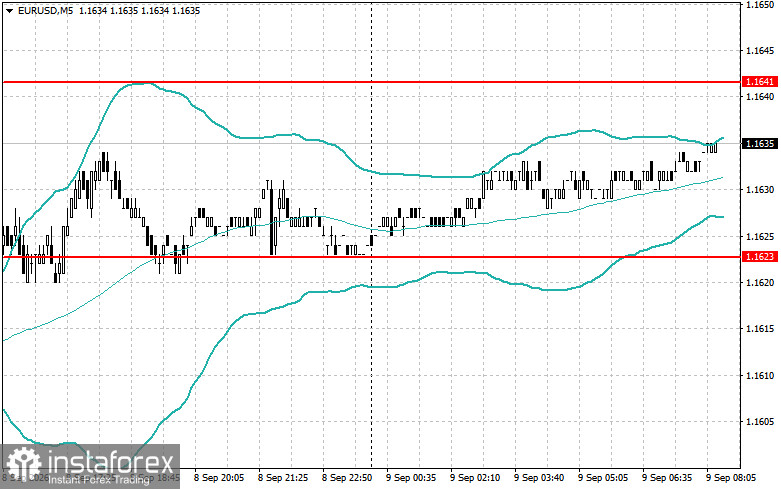
For EUR, the upper reference is 1.1641. Look to sell only after a failed attempt to hold above it, followed by a return below. Be extra cautious today: the general tone favors buyers, and selling into the pre-ECB background is risky. The lower limit is 1.1623: a failed breakdown followed by a return to the level is a buy setup — this option appeals to me more because it aligns with the market direction.
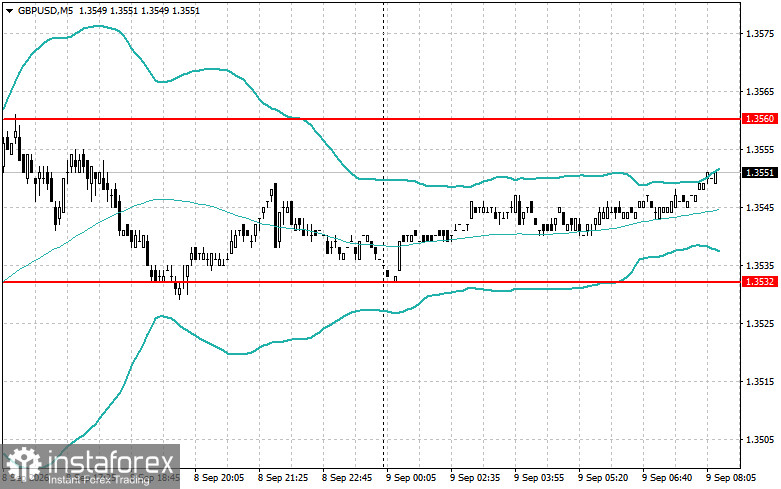
For GBP, the ranges are top 1.3560 and bottom 1.3532. The scheme is standard, and conditions are suitable: low volatility and no UK news create an environment where false breakouts are more frequent than real ones. In both cases, place stops beyond the extreme of the false breakout rather than at the nearest round number.
Today is logically clear. US data hinted at cooling, but the dollar did not press its advantage; the eurozone calendar is light; attention is already shifted to tomorrow's ECB decision. In this setup, I prioritize long positions on the euro—both from a confirmed breakout above the upper boundary and from a failed downside breakout back to the lower boundary—and treat short positions only as short, reactive trades after failed continuation attempts. For the pound, I do not expect an independent move; I prefer to trade from the range boundaries until the dollar shows direction.


