
Veja também


 09.09.2026 10:00 AM
Markets closed lower yesterday. The S&P 500 fell by 0.58%, the Nasdaq 100 slid by 0.32%, and the Dow Jones Industrial Average lost 1.18%.
The main pressure on equities today comes from the Middle East. Brent crude jumped by 1.8% to $99.68/bbl after US strikes on Iranian tankers near Kharg Island, a key Iranian export hub. The benchmark has approached $100 for the first time since July and is up more than 60% year-to-date. Asian chip stocks, however, continued to rally: South Korea's Kospi gained 1.3%, and the MSCI Asia Pacific index rose by 0.4%.
The more worrying element was not only the oil move but Tehran's warning. The Islamic Revolutionary Guard Corps, via state television, ordered tanker crews near ports in Kuwait and Bahrain to immediately abandon ship, whether at anchor or berthed, warning they would be targeted. The threat now extends beyond transit routes to port infrastructure in countries not directly involved in the conflict.
Despite the headline correction, markets are holding up reasonably well. Demand for AI exposure remains high, and many investors appear less concerned about a Fed rate hike, prioritizing earnings prospects over higher borrowing costs. How long that selective complacency lasts depends on oil: if Brent sustains a level above $100 and inflation expectations begin pushing long yields higher, risk assets, especially richly valued tech names, would be vulnerable. August's sell-off in chipmakers already illustrated this: the MSCI World Semiconductor index fell by more than 20% from its June peak.
A separate subplot involved the yen and US Treasury Secretary Scott Bessent, whose currency-market rhetoric crossed conventional bounds. Bessent urged traders to trade against his attempts to strengthen the yen, saying that his market forecasts are effectively based on insider knowledge. The yen strengthened for a third day, rising by 0.4% to 153.40 per dollar, while the dollar index eased by 0.1%.
I view such public statements from a Treasury official as a risk that the market is underestimating. Claiming access to "insider" information while inviting traders to trade against you blurs the line between currency policy and market manipulation. Recall that doubts about US institutions already pushed the dollar to its May low in late August, and Treasury intervention in the bond market at that time reignited concerns over distorted price discovery.
All attention now shifts to Friday's inflation prints. Economists expect headline CPI to rise by 0.4% in August — a month-on-month acceleration partly driven by higher gasoline — while core CPI is forecast at a more moderate 0.2%. That would pull annual core inflation down to about 2.4%, the smallest year-over-year increase since 2021.
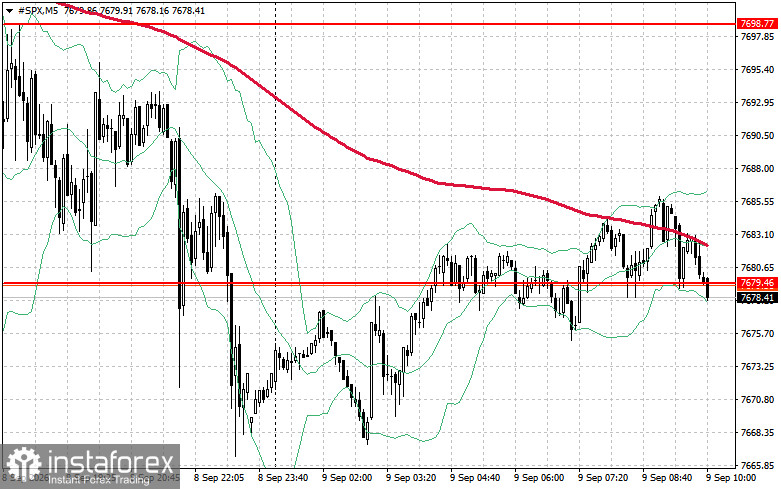
Technically, the S&P 500 chart indicates that the immediate task for buyers is to overcome the resistance level of 7,698. That would signal renewed upside and open the path to 7,718. Holding above 7,737 would further strengthen the bulls' case. On the downside, buyers must defend 7,679. A break below that level would likely push the index to 7,656 and open the way to 7,633.


