
Vea también


 24.06.2026 06:36 PM
Review of Trades and Trading Recommendations for the Japanese Yen
The test of the 161.78 level occurred when the MACD indicator had already moved significantly above the zero line, which limited the pair's upward potential. A second test of 161.78 triggered Sell Scenario No. 2, but the pair failed to develop a substantial decline.
Today's U.S. economic calendar is expected to be eventful. New home sales data will be the most important release to watch. An increase in sales is typically associated with stronger consumer confidence, greater availability of mortgage financing—which may face challenges in the near future—and overall improvement in housing market activity. A positive reading would support the U.S. dollar.
The current account balance is a comprehensive indicator reflecting all of a country's financial transactions with the rest of the world. The dynamics of this indicator help determine whether a country is a net creditor or a net debtor within the global economy. An improvement in the current account balance is positive for the dollar, while a deterioration would be negative.
As for my intraday strategy, I will primarily focus on the implementation of Scenarios No. 1 and No. 2.
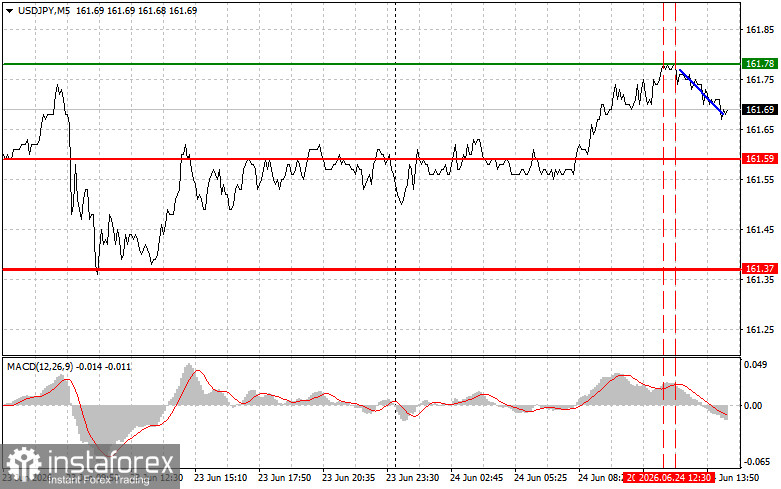
Buy Signal
Scenario No. 1: Today, I plan to buy USD/JPY upon reaching the entry level of 161.79 (green line on the chart), targeting a rise to 162.07 (the thicker green line on the chart). Around 162.07, I plan to close long positions and open short positions in the opposite direction, targeting a 30–35 point move from that level. Further gains in the pair are possible today, although the upward potential appears limited.
Important: Before buying, make sure that the MACD indicator is above the zero line and is just beginning to move higher from it.
Scenario No. 2: I also plan to buy USD/JPY if there are two consecutive tests of the 161.63 level while the MACD indicator is in oversold territory. This would limit the pair's downward potential and trigger a bullish market reversal. In this case, a rise toward the opposite levels of 161.79 and 162.07 can be expected.
Sell Signal
Scenario No. 1: I plan to sell USD/JPY after a break below the 161.63 level (red line on the chart), which could trigger a rapid decline in the pair. The key target for sellers will be 161.37, where I plan to close short positions and immediately open long positions in the opposite direction, targeting a 20–25 point move. Pressure on the pair could return today in the event of intervention by the central bank.
Important: Before selling, make sure that the MACD indicator is below the zero line and is just beginning to move lower from it.
Scenario No. 2: I also plan to sell USD/JPY if there are two consecutive tests of the 161.79 level while the MACD indicator is in overbought territory. This would limit the pair's upward potential and trigger a bearish market reversal. In this case, a decline toward the opposite levels of 161.63 and 161.37 can be expected.
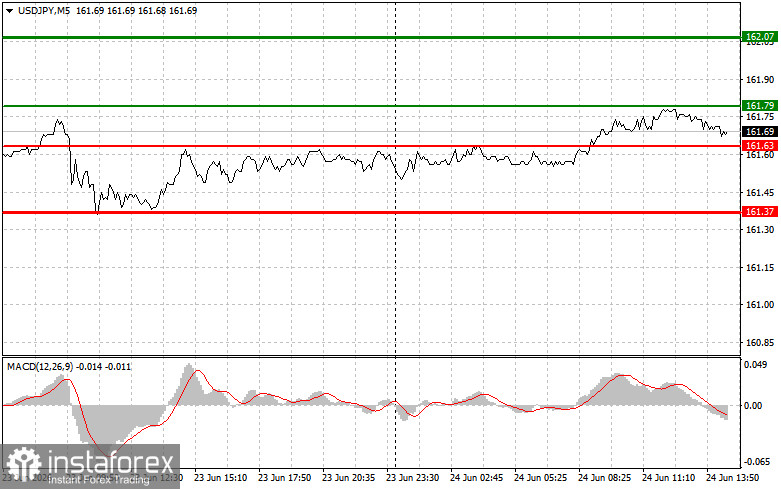
Chart Notes:
Important:
Beginner Forex traders should exercise extreme caution when making market entry decisions. It is best to stay out of the market before the release of important fundamental reports to avoid exposure to sharp price fluctuations. If you choose to trade during news releases, always use stop-loss orders to minimize potential losses. Without stop-loss orders, you can lose your entire deposit very quickly, especially if you trade large volumes without applying proper money management principles.
Remember that successful trading requires a clear trading plan, such as the one outlined above. Making spontaneous trading decisions based solely on current market conditions is inherently a losing strategy for an intraday trader.


