
Lihat juga


 15.09.2026 05:42 PM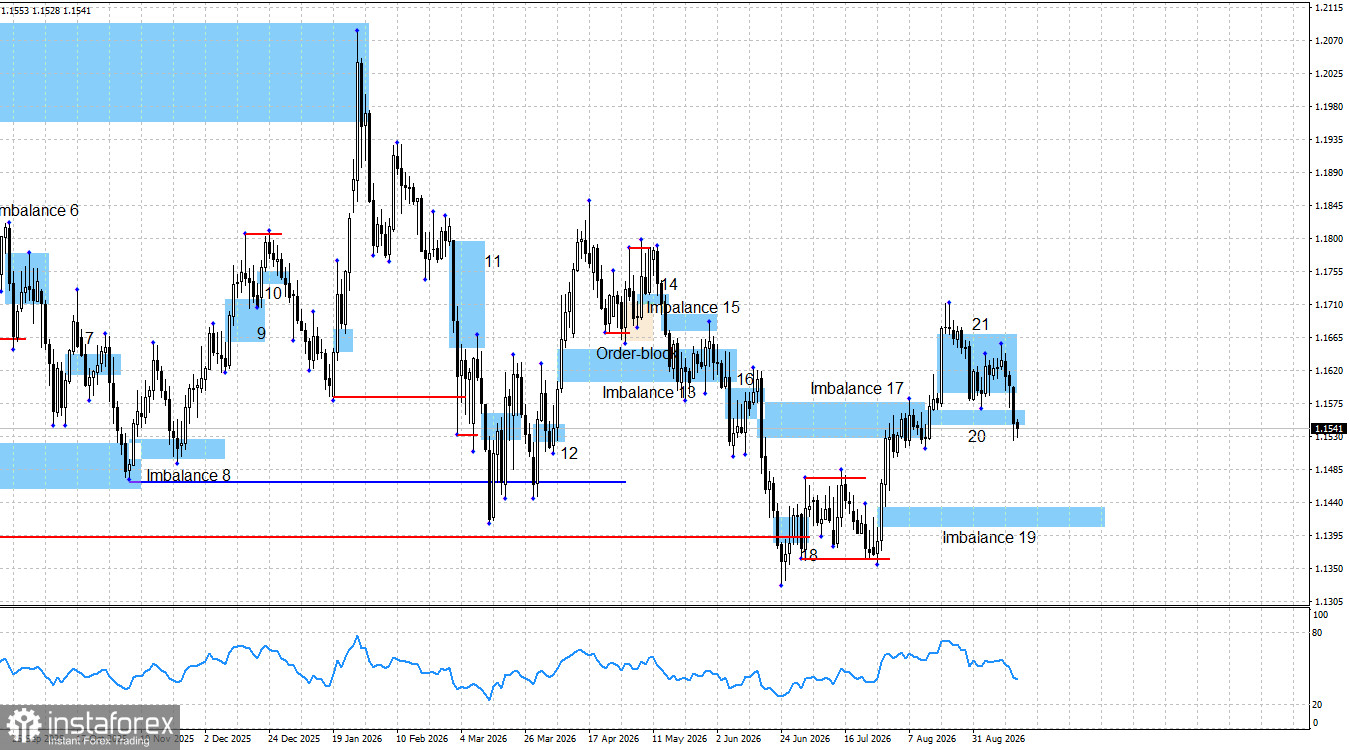
The EUR/USD pair has lost around 100 points over the past three days. Interestingly, the decline in the euro began last Thursday, when the ECB made a fully hawkish decision that would have allowed the bulls to continue their advance. However, at the most critical moment, the bulls once again retreated and gave up, essentially without a fight. Let me remind you that the main reason for the bears' current strength is the Fed meeting, at which traders expect monetary policy tightening. Heated debate continues in the market over whether Kevin Warsh will be able to distance himself from the White House and Donald Trump personally, who appointed him as the head of the FOMC, and make a decision to tighten monetary policy. There is also debate over whether it makes sense to raise rates specifically in September. Opinions are divided, and there is no definitive answer even just one day before the outcome is announced, despite the fact that all the necessary labor-market and inflation data are available. In my view, the question now is whether the dollar got ahead of itself and whether the market has started buying the dollar too aggressively and without sufficient grounds. Clearly, FOMC policy tightening is a bullish factor for the U.S. currency, but at the same time, the dollar has been rising for three full days. Is that not enough as a reaction to a hawkish Fed decision that has not even actually been made yet? Bullish imbalance 20 can still be considered valid, as the price has not broken through its base. Thus, the bulls have not left the market; they have merely retreated somewhat.
Overall, in my view, the information backdrop remains on the bulls' side. First, any chart clearly shows that the euro began its rise from relatively low levels, compared with the average price over the past year. This means that there is still upward potential. Second, the market continues to doubt that the FOMC will tighten monetary policy in September, regardless of what statements Warsh makes. Third, U.S. economic data have recently been disappointing for the most part. Fourth, geopolitical factors no longer support the bears or the dollar. Fifth, the ECB has already tightened monetary policy twice in 2026. Sixth, the U.S. Treasury has decided to increase its purchases of long-term bonds, which reduces demand for the dollar. Seventh, a trade war has begun between the United States and Canada. Eighth, the U.S. labor market in 2026 is doing only slightly better than it did in 2025. Thus, I currently see no reason at all for a bearish advance.
The current chart picture indicates a break in the bullish momentum, which nevertheless may still hold. Bullish imbalance 21 provided the bulls with an excellent opportunity to continue the advance that began back in June, but this pattern was invalidated. The bulls' only hope now lies in bullish imbalance 20, which cannot yet be considered invalidated. Thus, a reaction to this pattern may still occur, although now virtually any further decline in the euro, even a minimal one, will invalidate this pattern as well. Everything will be decided tomorrow evening.
The economic backdrop on Tuesday attracted little interest from traders, which is clearly visible in price movements. The ZEW Economic Expectations indices released in the morning did not trigger any market reaction. The weekly ADP report also failed to attract traders' attention. Thus, the market remains fully focused on the Fed meeting, as it is still impossible to say with certainty what decision will be made.
There are still numerous reasons for the bulls to attack in 2026. Structurally and globally, Trump's policies, which led to a significant decline in the dollar last year, have not changed. At present, I do not see any significant supportive factors for the U.S. currency despite the FOMC's hawkish stance. Geopolitical factors, which supported demand for the U.S. currency during most of the first half of 2026, no longer do so.
News calendar for the United States and the European Union:
On September 16, the economic events calendar contains six entries, of which we will highlight the last three, related to the Fed. The impact of the economic backdrop on market sentiment on Wednesday could be strong in the second half of the day.
EUR/USD Forecast and Trading Tips:
In my view, the pair remains in the process of forming a bullish trend that took a one-year pause. The information backdrop changed sharply in favor of the bears six months ago, but the trend itself cannot be considered canceled or complete. In the long term, I would say that the pair is trading in a range. However, the range does not invalidate the broader bullish trend. Thus, the bulls may resume their advance in 2026, but their only remaining opportunity is imbalance 20. A bearish imbalance may form as early as today, which could allow traders to open short positions in the future. The target for the euro's decline could be the 1.1406–1.1434 level. However, this would only be the case if imbalance 20 is ultimately invalidated.


