
یہ بھی دیکھیں


 09.09.2026 09:50 AM
Brent is trading near $99–$100 per barrel after recent events. U.S. forces destroyed five Iranian oil tankers on Tuesday in response to two attempted ballistic-missile strikes on a U.S. Navy ship; the vessels belonged to the IRGC, and crews were ordered off before strikes rendered them inoperable. On Saturday, three more tankers were destroyed after an unsuccessful attempt to attack a U.S. carrier and destroyer with cruise missiles.
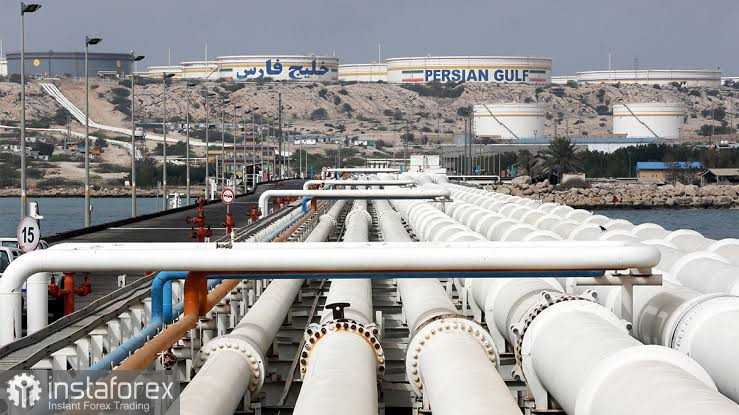
Brent is around $99/bbl and continues rising after reports of explosions near the anchorage at Kharg Island. That detail determines the scale of market risk: Kharg lies about 24 km off the coast and is the loading point for roughly 90% of Iran's oil exports.
The causal chain from strikes to prices is shorter and harsher now than in earlier episodes. Previously, attacks hit individual vessels in the strait; explosions at Kharg damage export infrastructure through which almost all Iranian exports pass. Winners are producers outside the Gulf, whose oil becomes more expensive without extra cost; losers are Asian buyers of Iranian crude—chiefly China—and global refined-product consumers, for whom reduced supply means higher fuel prices.
Beyond the energy market, the top problem again is inflation. The ISM services prices measure surged to 72.6—the highest since August 2022—manufacturing prices hit 71.1, and the 12-month average rose to 68.5% for the eighth consecutive month. European gas futures reached 2023 levels while storage sits at only 65% ahead of winter. US diesel margins have hit record highs.
This exposes the key contradiction of current US strategy. In August, the administration said it would emphasize economic strangulation of Iran and avoid a broad military restart; Treasury Secretary Scott Bessent said pressure operations implied likely absence of large-scale re-escalation. Trump repeatedly claimed Iranian forces had been degraded below the ability to attack US assets. Reality proved different: exchanges resumed, and the economic strangulation plan remains mainly a plan. Short of a decisive military result, the U.S. so far cannot fully choke Iranian exports.
How large is the risk of a full halt to Iranian exports? I am convinced the market underestimates it, for geographic reasons. If a single tanker is hit, cargo can be rerouted; if Kharg's loading facilities are damaged, almost the entire export channel is knocked out at once. Iranian shipments were already constrained by US maritime measures, but China continues to buy, and the physical loss of those volumes will tighten an already scarce balance.
Recall the initial scale: before the war (Feb 28), about one-fifth of global oil and LNG shipments transited the Strait of Hormuz. Now the US fleet is blocking Iranian oil shipments while Iran fires on international vessels attempting to leave the Gulf. Both mechanisms reduce supply simultaneously from different sides.
I expect Brent to overcome $100 in the coming sessions and settle in a $100–$110 range, because the Kharg-infrastructure risk is qualitatively different from earlier threats against individual ships.
Political risk could reverse the strikes on Kharg. With November midterm elections in the United States approaching, high pump prices may force the US administration to change course quickly.
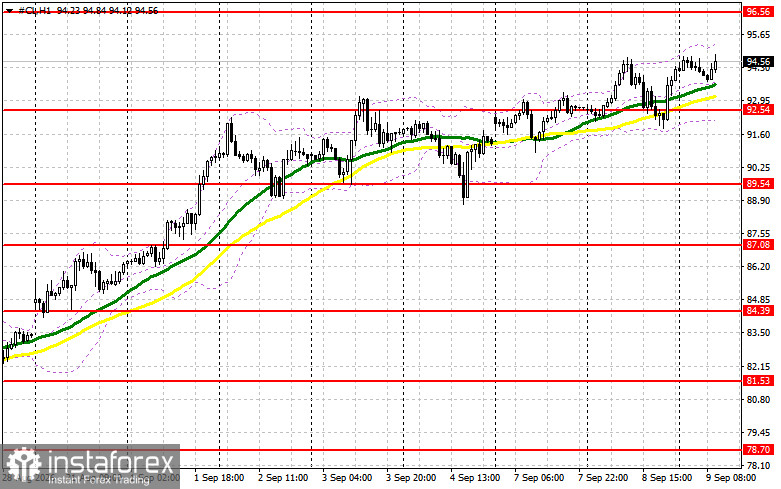
As for the current technical picture of oil, buyers need to reclaim the nearest resistance of $96.50. This will allow you to aim for $ 100.40, above which it will be quite difficult to break through. The furthest target is $103.40. If oil drops, the bears will try to take control of $92.54. If this happens, a break below the range will deal a serious blow to the bulls' positions and push oil to a low of $89.54, with the prospect of reaching $87.10.


