
یہ بھی دیکھیں


 23.09.2026 06:08 PM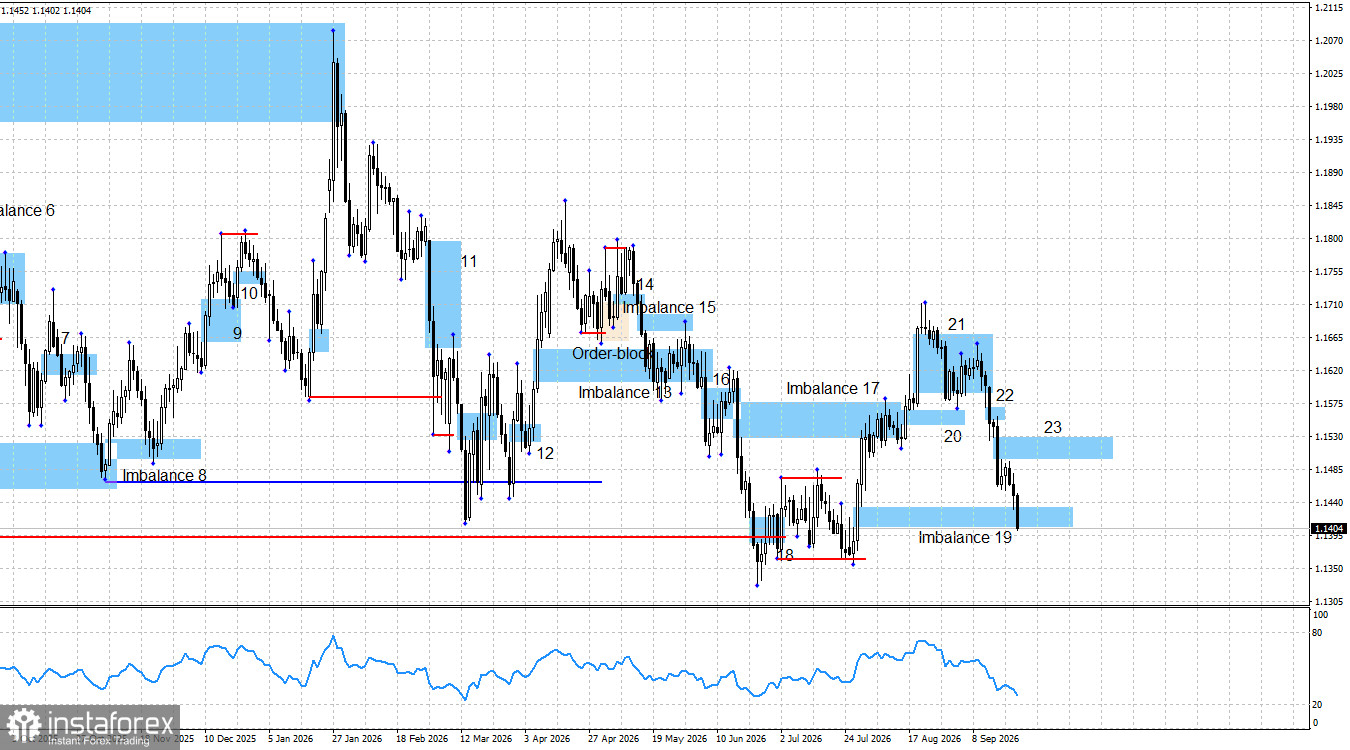
EUR/USD has continued to decline for ten consecutive days. During this period, the European currency has lost 230 points. The decline in the European currency began the week before last as the market prepared for an FOMC rate hike. Since then, the market has continued to buy the dollar based on the Fed's hawkish stance on monetary policy. Nothing can currently stop the decline in the euro. Neither tighter ECB policy, nor positive economic data from the European Union, nor the technical picture and bullish patterns can reverse the decline. If imbalance 19 is invalidated, the European currency will not simply continue to decline but will have a strong chance of falling below the psychological level of $1.10. At present, everything indicates that imbalance 19 will be invalidated. At the same time, bearish imbalance 23 has formed, and its presence further strengthens the bears' prospects. Thus, we continue to observe a sharp decline in the euro while the ECB is tightening its policy. The bears are currently extremely strong, and the bulls have nothing to counter them with.
Last week, the FOMC indicated its readiness to continue tightening policy, which was enough to trigger another advance by the bears. Even after the Fed tightened monetary policy in September and potentially tightens it again in November or December, I do not see what other factors could cause traders to continue buying the US currency. The dollar has performed strongly in recent weeks, but what factors have supported it during this period? FOMC monetary policy tightening and nothing else?
Overall, the information backdrop, in my view, remains supportive of the bulls. Despite the Fed's more hawkish monetary policy stance, this is not the only factor determining exchange rates. However, at present, the only factor that matters is the strength of the bears and their willingness to continue selling. All other factors are having no impact on the market. Interestingly, the bears' advance could now end at any moment, as they have already been selling for three weeks more on momentum than on the basis of specific fundamental reasons. Thus, the euro's decline will end when the bears' selling pressure subsides. This could happen at any time.
The current technical picture indicates a breakdown of the local bullish momentum. Only imbalance 19 can save the bulls. I repeat: apart from FOMC policy tightening, I see no reason for the dollar to rise. Therefore, there are no fundamental grounds for the pair to continue declining below imbalance 19. However, this does not mean that imbalance 19 will stop the decline. A new bearish imbalance 23 has also formed, which may be used in the future to generate sell signals.
The economic backdrop on Wednesday provided the bulls with an opportunity to launch a counterattack. Business activity indices in the services and manufacturing sectors of the European Union were more positive than traders had expected, which should have helped the euro recover. It would have helped if the market had paid even a small amount of attention to this data. At present, the EU economy can produce any results, but this has no effect on the euro exchange rate because the bears are continuing to sell without interruption.
The bulls still have numerous reasons to remain active in 2026. Structurally and globally, Trump's policies, which led to a significant decline in the dollar last year, have not changed. At present, I see no significant factors supporting the US currency despite the FOMC's hawkish stance. Geopolitical factors, which supported demand for the US currency during most of the first half of 2026, are no longer doing so.
The September 24 economic calendar contains three releases, none of which I consider significant. The impact of the economic backdrop on market sentiment on Thursday will be extremely weak or nonexistent.
In my view, the pair remains in the process of forming a bullish trend that has paused for an entire year. The information backdrop shifted sharply in favor of the bears six months ago, but the broader trend cannot be considered canceled or complete. In the long term, I would say that the pair is trading within a range. A range does not invalidate the broader bullish trend. Thus, the bulls may resume their advance in 2026, but their only remaining opportunity is imbalance 19. With each passing day, the probability that this pattern will stop the euro's decline becomes lower. At present, the bears have only imbalance 23, which has not yet been tested. However, in my view, the current move is risky for traders because it lacks clear fundamental grounds. The dollar could certainly continue to rise even below the $1.10 level, but the question is: what would justify such a move?


