
আরও দেখুন


 31.08.2026 10:07 AM
Kevin Warsh's speech at Jackson Hole strengthened the US dollar, although traders initially tried to buy risk assets aggressively. The dollar rose because the key takeaway from his remarks was more hawkish than markets had expected. According to Warsh, the Fed's dominant focus should now remain on prices, and he is not convinced that the summer improvement in inflation data reflects a genuine turning point in the trend.
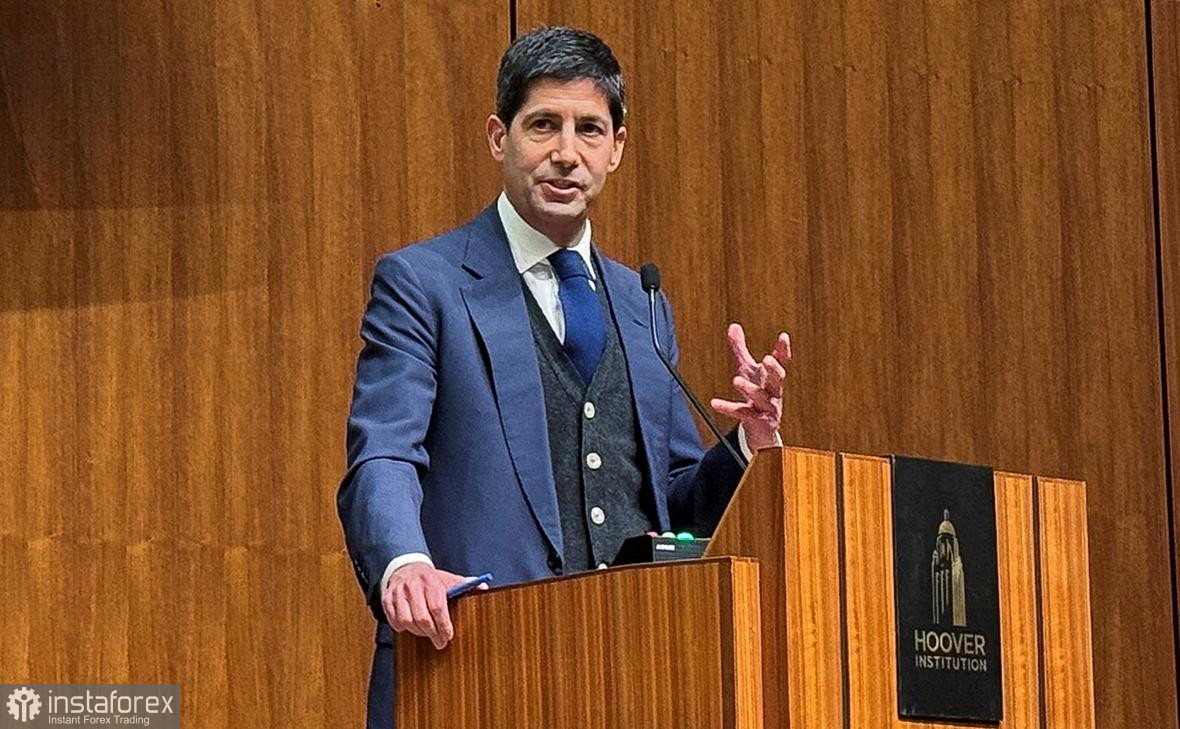
His assessment of the economy was especially telling. Warsh said he was impressed by the broader data, which in his view has strengthened, and he offered specific arguments. Business capital spending is rising rapidly: annual growth in investment in equipment and intangible assets was about 9%, the highest since 2021, and more than half of that increase this year can be attributed to the build-out of AI infrastructure. Earnings at S&P 500 companies rose more than 20% over the year, while margins exceeded historical levels. That is the foundation of the key conclusion that makes the speech hawkish.
Warsh said credit markets are showing few signs that policy is restraining activity, adding that apart from certain sectors such as housing and agriculture, where strains are visible, it would be difficult to characterize broader financial conditions as restrictive. As noted earlier, that is the same argument used by hawks within the Fed, including Jeff Schmid, and it also appeared in the ECB's July minutes.
Warsh's methodology for measuring inflation is also worth noting because it explains his skepticism. The 12-month change in the PCE index stands at 3.7%, while the six-month figure is 4.1%. To assess the underlying trend, he breaks down 199 individual components of the index: over the past 12 months, 54% of goods and services in the basket posted price growth above 3%, well below the post-pandemic peak of about 77% but materially above the 32% norm that prevailed in the two decades before the pandemic. Over the past six months, the figure was 49%. In other words, price pressure remains broad rather than isolated.
His assessment of employment was far calmer. Warsh described the 4.1% unemployment rate as low by historical standards and called the four-week average of jobless claims an empirically reliable real-time indicator, one that remains close to multi-decade lows. He explained weak payroll growth in structural terms: when labor supply is barely growing, monthly job growth will naturally be low. The implication is clear: in his view the labor market is consistent with full employment, which means there is no labor market justification for easier policy.
The institutional part of the speech also deserves attention because Warsh effectively buried the practice of forward guidance. Introducing the structure of his remarks, he joked that it could be called a plan or a road map, but not forward guidance. He said transparency in communicating future decisions is not a virtue in itself, and that the use of forward guidance, introduced during the financial crisis, has outlived its usefulness. He described the risk of mutual dependence between the central bank and markets as a hall-of-mirrors problem: if markets rely too heavily on Fed guidance and the Fed relies on market prices, all parties become more blind to new developments and more prone to mistakes.
The climax of the speech was a direct acknowledgment of responsibility. Warsh said there is one signal no one can miss: responsibility for 65 months of persistently elevated inflation lies squarely with the central bank. He then set out his condition for further action: the Fed must be confident that underlying inflation is moving toward the target clearly and at sufficient speed. Otherwise, there is still work to do.
As noted above, the dollar responded by strengthening against risk assets, because there is no basis for a dovish narrative in the near term.
The current technical picture for EUR/USD suggests that buyers now need to think about taking the 1.1598 level. Only that will allow a target a test of 1.1620. From there it will be possible to reach 1.1639, but doing so without support from large players will be difficult. On the downside, I expect any serious buying to be only around 1.1572. If there are no buyers there, it will be better to wait for a fresh low at 1.1554 or to open long positions from 1.1534.
The current technical picture for GBP/USD shows that pound buyers need to take the nearest resistance level of 1.3551. Only that will allow a move toward 1.3574, above which further progress will be difficult. The farther target is the 1.3596 area. On a decline, bears will attempt to seize control of 1.3527. If they succeed, a break of the range will inflict a serious blow to bulls and push GBP/USD toward a low of 1.3502 with the prospect of extending to 1.3475.


