
Lihat juga


 23.06.2026 12:17 AM
An obvious answer to this question is "Because the Labour Party suffered a crushing defeat in the elections a month ago." However, upon closer examination, Keir Starmer was not the worst prime minister in UK history. It is hard to say he was worse than Liz Truss or Boris Johnson. The problem likely lies in the inflated expectations of the British people themselves. After the country left the European Union, the standard of living for the British population fell sharply. It decreased to such an extent that, according to various sociological studies, many Brits changed their attitudes towards the EU and would like to return to the European alliance in the future. Therefore, every new government was expected to deliver significant and positive changes. If a prime minister could not show results that reflected on the wallets of British voters, he would immediately face severe criticism and lose trust.
Starmer's government achieved a 4.1% wage increase, a rise in the minimum living wage, a reduction in tariffs on cars, aluminum, and steel amid the trade confrontation with the U.S., and a decrease in the number of migrants. However, upon closer inspection, most of these "achievements" are not significant or substantial. Wages grew by only 4.1%, a normal occurrence given high inflation. The reduction in tariffs did not lower the initial price of cars, aluminum, and so on. Donald Trump started a trade war, and Starmer was only able to mitigate its impact on the British people to a limited extent. The decrease in the number of migrants occurred because the country left the European Union, making entry rules much stricter. Furthermore, migrants were mostly engaged in "black work," which Brits are unwilling to do. Therefore, a decrease in the number of migrants is a rather questionable achievement.
As for failures, the most notable is social policy. Since the Conservatives left a huge "gap" in the budget, Starmer had to patch it. He had to cut spending on social programs and raise certain taxes, which was unlikely to please any voters. The "Peter Mandelson affair," which was mentioned in the "Epstein files," is also cited as a failure. Starmer fired Mandelson, but the unpleasant aftertaste remains.
Considering all of the above, the main problem for Starmer has been the lack of outstanding results demanded by British voters. When it came time for new elections, the British voted not for the Labour Party and not even for the Conservatives. Now, Britain will have its seventh prime minister in the last 10 years.
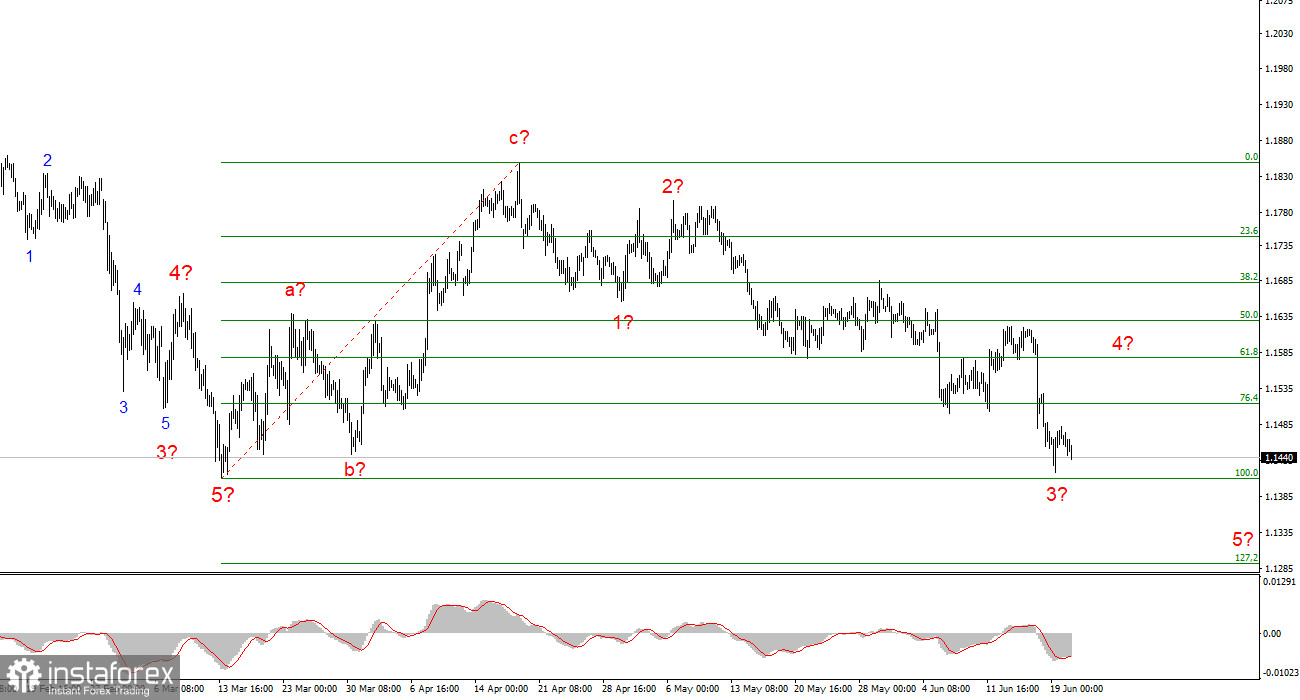
Based on the analysis of EUR/USD, I conclude that the instrument remains within an upward segment of the trend, while in the shorter term, it is within a downward segment that may be nearing completion. In my opinion, it is a good time to attempt to form long positions, but the instrument may drop below the 14 level within wave C. If this assumption holds, it would be better to wait a bit longer. I believe the market will also take into account that the European Central Bank is tightening and the possibility that the geopolitical conflict between Iran and the U.S. may be resolved soon.
The wave picture for the GBP/USD instrument has become clearer. Currently, the instrument has built three waves down, while EUR/USD has formed five. Consequently, the pound may limit itself to forming a corrective structure, and both currency pairs could begin forming upward segments of the trend. At the moment, this is merely an assumption, but it is a plausible one. If it is correct, the instrument will begin to rise, with targets around the 35 level and above, and market participants currently have a good opportunity to purchase.


