Trade Review and Tips for Trading the Japanese Yen
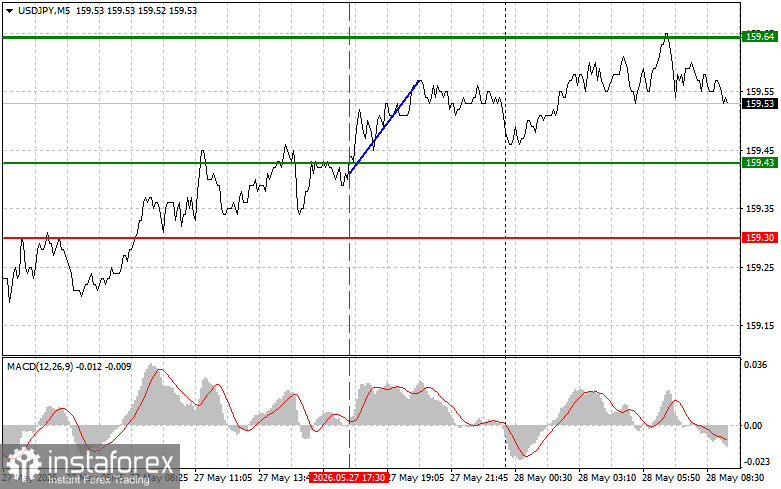
The test of the price at 159.43 coincided with the moment when the MACD indicator was just beginning to move up from the zero mark, confirming the correct buy entry point for the dollar. As a result, the pair rose nearly 15 pips.
Geopolitics remains the main driver of the dollar's growth and the Japanese yen's decline. The recent rise in geopolitical tension in the Middle East, exacerbated by military actions between the United States and Iran, as well as Israel's actions in Lebanon, continues to significantly affect traders' positions in the USD/JPY pair, forcing them to buy dollars and sell yen. Ongoing military conflicts and the unpredictability of developments in the Middle East create an atmosphere of uncertainty that will continue to pressure risk assets and support demand for the U.S. dollar. Traders will continue to closely monitor any news that may indicate an escalation or de-escalation of the conflict, as well as actions from central banks—especially the Bank of Japan and the U.S. Fed —which may seek to mitigate the negative consequences of such volatility. Keep in mind that if the yen approaches the level of 160, there is a high probability of intervention from the Japanese central bank.
Regarding the intraday strategy, I will primarily rely on implementing Scenarios #1 and #2.
Buy Scenarios
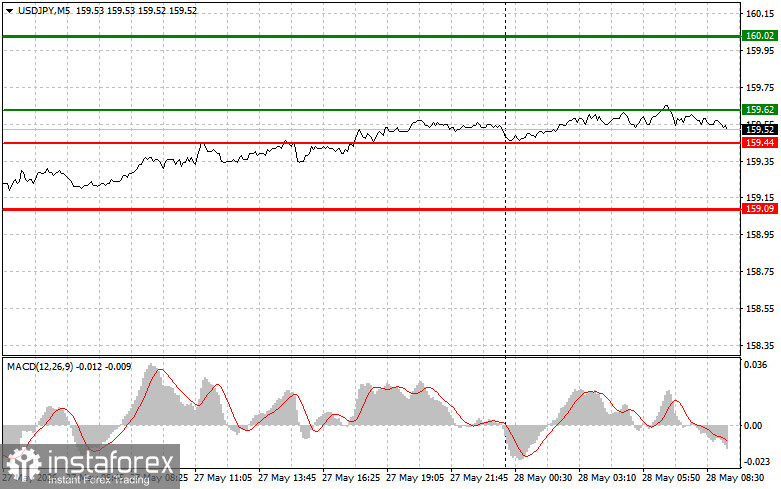
Scenario #1: I plan to buy USD/JPY today when it reaches an entry point around 159.62 (the green line on the chart), targeting a move to 160.02 (the thicker green line on the chart). At around 160.02, I plan to exit my long positions and open short positions back in the opposite direction (anticipating a movement of 30-35 pips from the level). It is best to return to buying the pair during corrections and significant pullbacks in USD/JPY. Important! Before buying, ensure the MACD indicator is above the zero mark and just beginning to rise from it.
Scenario #2: I also plan to buy USD/JPY today in the event of two consecutive tests of the price 159.44 when the MACD indicator is in the oversold area. This will limit the pair's downward potential and lead to an upward market reversal. A rise can be expected towards opposing levels of 159.62 and 160.02.
Sell Scenarios
Scenario #1: I plan to sell USD/JPY today only after the 159.44 level is updated (red line on the chart), which will trigger a rapid decline in the pair. The key target for sellers will be the level of 159.09, where I plan to exit my shorts and also open longs back in the opposite direction (anticipating a move of 20-25 pips from the level). Sellers could return at any moment; we just need a hint from the central bank. Important! Before selling, ensure the MACD indicator is below the zero mark and just beginning its decline from it.
Scenario #2: I also plan to sell USD/JPY today in the event of two consecutive tests of the price 159.62 when the MACD indicator is in the overbought area. This will limit the upward potential of the pair and lead to a market reversal downward. A decrease can be expected towards opposing levels of 159.44 and 159.09.
What the Chart Indicates:
Thin Green Line: Entry price for buying the trading instrument;
Thick Green Line: Estimated price where take profit can be set or profits can be locked in, as further growth above this level is unlikely;
Thin Red Line: Entry price for selling the trading instrument;
Thick Red Line: Estimated price where take profit can be set or profits can be locked in, as further decline below this level is unlikely;
MACD Indicator: When entering the market, it's important to consider the overbought and oversold zones.
Important Note:
Novice Forex traders must be very cautious when making market entry decisions. It is best to stay out of the market before important fundamental reports are released to avoid sharp fluctuations. If you decide to trade during news releases, always set stop orders to minimize losses. Without placing stop orders, you can quickly lose your entire deposit, especially if you do not use money management and trade large volumes.
Remember that successful trading requires a clear trading plan, similar to the one presented above. Making spontaneous trading decisions based on the current market situation is inherently a losing strategy for intraday traders.
You have already liked this post today
*यहां पर लिखा गया बाजार विश्लेषण आपकी जागरूकता बढ़ाने के लिए किया है, लेकिन व्यापार करने के लिए निर्देश देने के लिए नहीं |



 28.05.2026 08:57 AM