
यह भी देखें


 28.05.2026 01:32 PM
Analysis of Trades and Trading Tips for the Euro
Due to low market volatility, the price did not reach the levels I identified during the first half of the day.
In the second half of the day, market participants will face a heavy flow of macroeconomic releases. The information block will begin with revised US GDP data for the January–March period of this year, along with fresh weekly initial jobless claims figures. The final part of the session will bring reports on changes in household income and spending, culminating with the key Personal Consumption Expenditures (PCE) Price Index. Such a large volume of information will inevitably trigger a surge in market volatility, providing analysts with fresh material to reassess the current state of the world's largest economy.
Nevertheless, the true focus of traders' attention and the key event of the evening will be the consumer sector. The Core PCE Index is traditionally regarded by policymakers as the most accurate tool for measuring inflationary pressure. Market participants will closely examine trends in consumer income and spending in an attempt to understand the resilience of consumer demand. The figures released today may not only summarize the quarter's performance but could also determine the broader direction of interest rate dynamics. Many market participants expect the Federal Reserve to adopt a more hawkish stance and increase borrowing costs further. All of this is positive for the US dollar and negative for the euro.
As for the intraday strategy, I will rely primarily on the implementation of Scenarios No. 1 and No. 2.
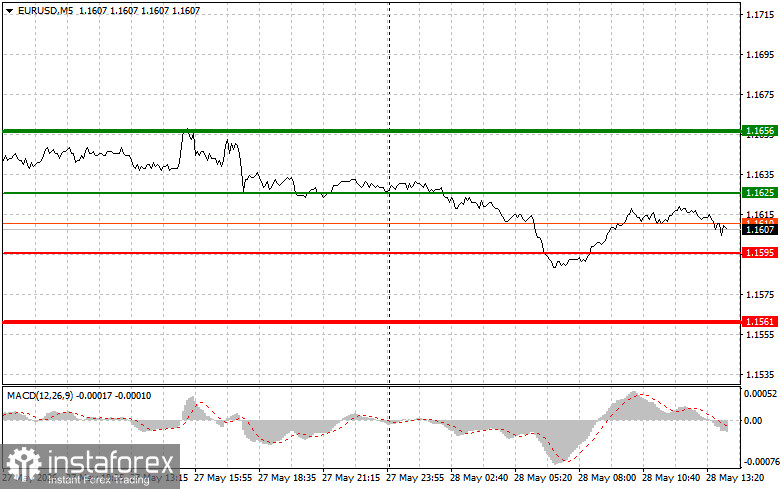
Buy Signal
Scenario No. 1: Today, I plan to buy the euro upon reaching the 1.1620 level (green line on the chart), targeting growth toward 1.1656. At 1.1656, I plan to exit the market and also open sell positions in the opposite direction, expecting a movement of 30–35 points from the entry level. Euro growth today can only be expected after strong economic data. Important! Before buying, make sure that the MACD indicator is above the zero mark and is just beginning to rise from it.
Scenario No. 2: I also plan to buy the euro today in the event of two consecutive tests of the 1.1601 level while the MACD indicator is in oversold territory. This would limit the pair's downward potential and lead to a market reversal upward. Growth toward the opposite levels of 1.1620 and 1.1656 can then be expected.
Sell Signal
Scenario No. 1: I plan to sell the euro after the price reaches the 1.1601 level (red line on the chart). The target will be the 1.1561 level, where I plan to exit the market and immediately open buy positions in the opposite direction, expecting a movement of 20–25 points from the level. Pressure on the pair is likely to return today if strong GDP data are released. Important! Before selling, make sure that the MACD indicator is below the zero mark and is just beginning to decline from it.
Scenario No. 2: I also plan to sell the euro today in the event of two consecutive tests of the 1.1620 level while the MACD indicator is in overbought territory. This would limit the pair's upward potential and lead to a downward market reversal. A decline toward the opposite levels of 1.1601 and 1.1561 can then be expected.
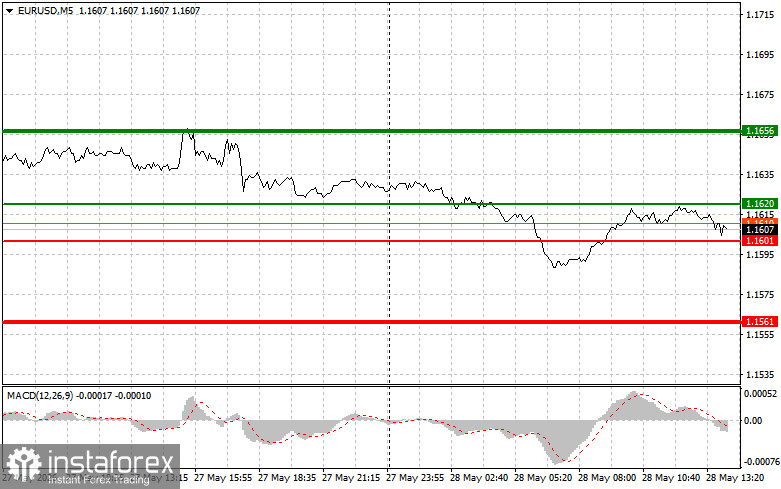
What Is Shown on the Chart:
Important. Beginner Forex traders should make market entry decisions very carefully. Before the release of important fundamental reports, it is best to stay out of the market to avoid sharp price fluctuations. If you decide to trade during news releases, always place stop-loss orders to minimize losses. Without stop-loss orders, you can lose your entire deposit very quickly, especially if you do not use proper money management and trade large volumes.
And remember that successful trading requires a clear trading plan, such as the one presented above. Spontaneous trading decisions based solely on the current market situation are inherently a losing strategy for intraday traders.

