
यह भी देखें


 31.08.2026 11:52 AM
Kevin Warsh's speech in Jackson Hole turned out to be tougher than expected in content but lacking specifics on timelines, and this combination creates an unusual construction for the dollar. Formally, each key point made by the Fed Chair supports the strengthening of the American currency; however, the refusal to make any promises deprives the market of the opportunity to price in future tightening in advance.
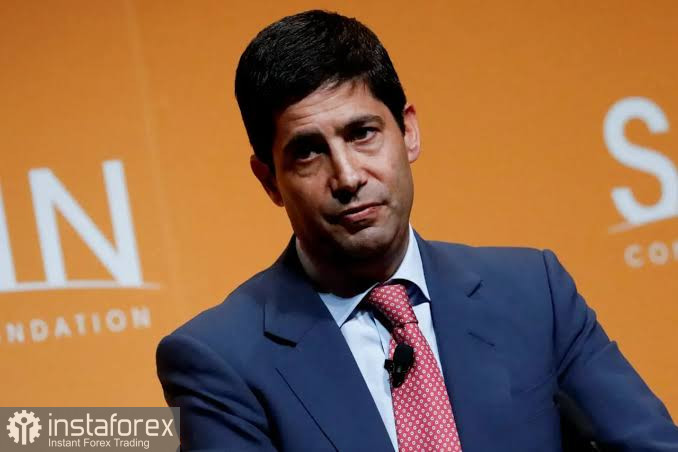
It's worth starting with the foundation of the entire speech. By stating that "the Fed's prevailing focus should now be on prices," Warsh effectively prioritized the dual mandate, placing it in favor of inflation. This is a direct positive for the dollar: when the regulator publicly declares the fight against prices as the main task, the market is obliged to price in higher rates over a longer horizon, and the interest rate differential remains a key driver of currency exchange rates. The effect is further amplified by the acknowledgment of responsibility for 65 months of elevated inflation: the Chairman, who publicly takes responsibility for the regulator, thereby commits to correcting the situation rather than explaining it away with external shocks.
However, the most significant for the currency market was another block. Warsh stated that he would "find it difficult to characterize broad financial conditions as restrictive," and the credit markets "demonstrate little sign of restraint from policy." This is not an evaluation of inflation but rather an assessment of the policy itself, indicating that the current 3.50-3.75% range, in the Chair's view, is not slowing the economy. Thus, raising the rate to achieve the target makes sense, and this point undercuts the main argument of the doves. Add to this the conclusion that "labor markets are consistent with full employment," and the Fed has no employment-related justifications to hold it back from tightening. This is the strongest part of the speech for the dollar.
The thesis regarding the nature of inflation deserves special attention. By calling the 2% target "firm and fixed" and emphasizing that "inflation does not necessarily return to the mean," Warsh rejected the scenario where price pressure would dissipate on its own as the energy shock fades. This is critically important for the currency market, as a significant part of the current inflation is linked to the conflict around the Strait of Hormuz, and one might logically expect the regulator to prefer to wait it out. Warsh made it clear that he has no intention of waiting, and his skepticism regarding the summer data improvements, which "do not indicate that underlying trends have substantially improved," closes this loophole as well.
I remind you that in August, the American currency fell to its lowest since May, while gold increased by more than 13%, with the driver of the metal's growth being doubts about the resilience of American finances after the Treasury was forced to buy long bonds to contain yields. Warsh's final formula of being "committed to discipline, not decision" shows determination but does not offer specific commitments.
The situation arises where, in the short term, the dollar receives support from the hawkish tone that removes the question of a September easing, while the medium-term trajectory depends on whether the market perceives the refusal of guidance as a demonstration of strength or as an acknowledgment of uncertainty. If Warsh does indeed raise the funds rate in September or confirms the intention to do so by the end of the year, the dollar will gain fundamental support. However, if the market decides that behind the tough rhetoric lies an inability to cope with yields in the absence of actions, the effect will be the opposite, and the strength will quickly shift to a continuation of the weakness seen in August.

