
यह भी देखें


 21.07.2026 05:38 PM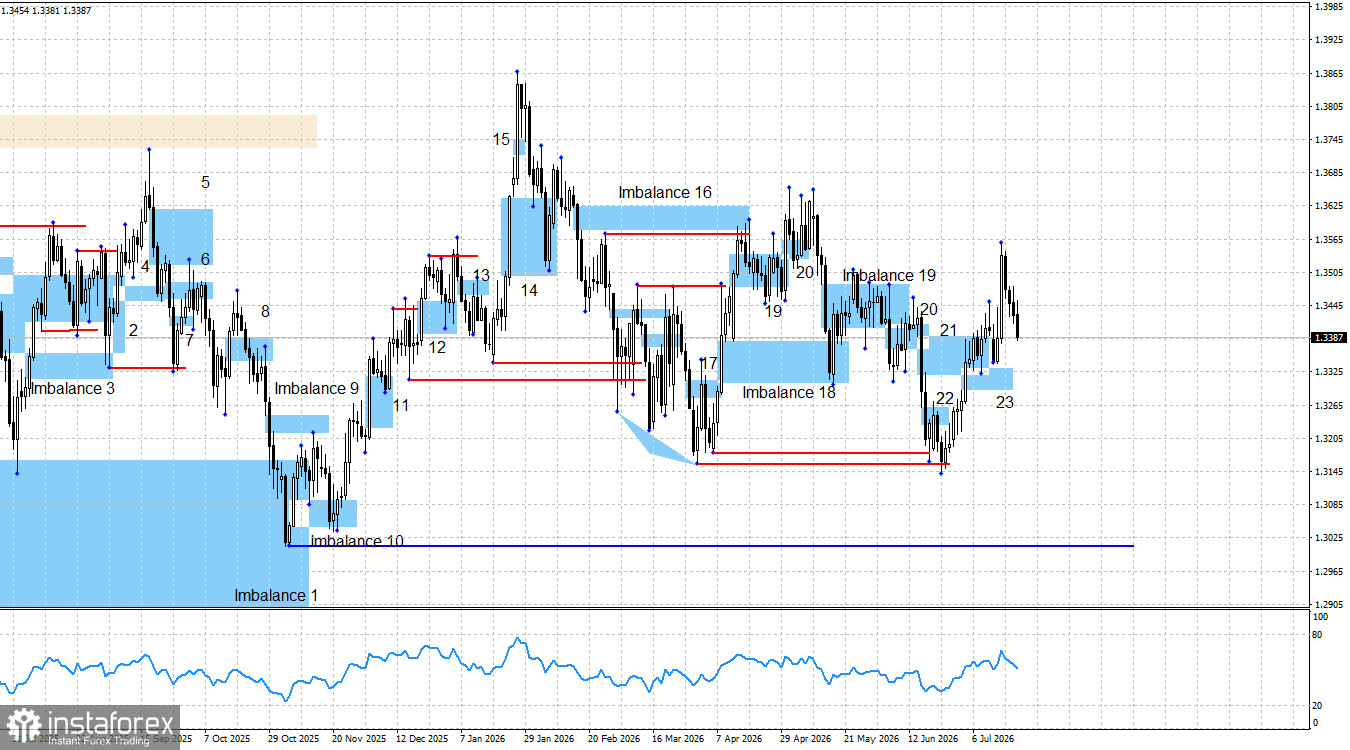
Over the past few weeks, the GBP/USD pair has posted strong gains that could mark the beginning of a new bullish trend. However, bullish traders now need at least a brief pause. The pound's advance has been rapid, and moves of this magnitude rarely continue uninterrupted for long. Therefore, I expect a corrective pullback, which has already begun and may last for several weeks.
Last week, bullish traders received an unexpected boost as U.S. inflation fell to 3.5%. This was followed by Kevin Warsh's testimony before Congress, during which he refrained from signaling further monetary policy tightening, triggering another wave of disappointment. As a result, there is no longer any certainty that the Federal Reserve will tighten monetary policy as early as September. By then, the market will also have a clearer picture of the conflict in the Middle East, autumn oil and natural gas prices ahead of winter, and how inflation responds to the evolving geopolitical and energy environment. Once these factors become clearer, it will be easier to assess the FOMC's next policy steps. Meanwhile, discussions of a renewed ceasefire in the Middle East have resumed, while Yemen's Houthi movement has announced a maritime blockade of Saudi Arabia. As a result, market sentiment could shift in either direction at any moment, and the future path of GBP/USD will largely depend on these developments.
Initially, the market expected U.S. inflation to accelerate unless the FOMC intervened. Later, inflation risks eased as oil prices fell to $70 per barrel. This week, however, oil has climbed to $91, and the consequences of the renewed escalation in the Middle East and the blockade of the Strait of Hormuz could potentially push prices as high as $120 per barrel. Under the most pessimistic scenario, oil could return to the $100–120 level. In that case, hopes for slowing inflation in either the United States or the Eurozone would quickly fade. Conversely, under a more optimistic scenario, oil prices could return to the $60–70 level, reducing the need for further Federal Reserve policy tightening.
From a technical perspective, price action continues to favor the bulls. The pair first swept liquidity below the April 6 low and then below the March 31 low. These liquidity grabs provided a solid basis for expecting further gains in the pound over recent weeks. Given that the U.S. dollar still lacks strong long-term bullish drivers and has already posted impressive gains in 2026, I believe the bears are unlikely to regain lasting control. The price reacted twice to Bullish Imbalance 23, providing buying opportunities for traders. Bearish Imbalance 21 has been invalidated. Therefore, I expect the pound to resume its advance after the current corrective pullback, which has been unfolding over the past few days. No new Smart Money patterns have emerged so far, meaning there are currently no new areas of interest for either long or short positions.
The economic data released on Tuesday was largely ignored by market participants. The UK published reports on the unemployment rate, claimant count change, and wage growth, with the unemployment report attracting the greatest attention. Contrary to expectations, the unemployment rate remained unchanged at 4.9%, meaning neither this report nor the accompanying releases was likely to trigger a decline in the pound. Traders continue to ignore most economic data.
The broader fundamental backdrop still leads me to expect only long-term weakness in the U.S. dollar. Neither the conflict between Iran and the United States nor the possibility of Federal Reserve rate hikes in 2026 has changed that view. Geopolitical tensions temporarily reminded the market of the dollar's safe-haven status, but the conflict has already moved beyond its most intense phase. The Federal Reserve intends to raise interest rates in 2026, which is supportive of the dollar. However, tighter monetary policy would also slow economic growth and weaken the labor market. Moreover, Donald Trump appointed Kevin Warsh as Chair of the FOMC to pursue a more accommodative monetary policy—something Jerome Powell, in Trump's view, was unwilling to deliver. Therefore, I believe that any appreciation of the U.S. dollar is likely to be temporary rather than the beginning of a sustained trend.
U.S. and UK Economic Calendar:
The economic calendar for July 22 contains only one event, but it is a highly significant one. Therefore, the economic backdrop is expected to influence market sentiment on Wednesday.
GBP/USD Forecast and Trading Tips:
The long-term outlook for the pound remains bullish. Following liquidity sweeps below the two most recent swing lows, the bulls regained the initiative. The pound could still resume its decline toward 1.3007, the level that would invalidate the bullish trend, but this would require fresh bearish signals, and no such signals or new patterns are currently present. The bullish case continues to be supported by the two liquidity sweeps and Bullish Imbalance 23. Although the market has already reacted to this imbalance, that bullish impulse has run its course and a corrective pullback is now underway. The next upward targets are the highs of May 1 and January 27, at 1.3656 and 1.3867, respectively. However, new long positions should be considered only after fresh Smart Money patterns emerge, and none are currently present.

