
यह भी देखें


 30.07.2026 07:35 PM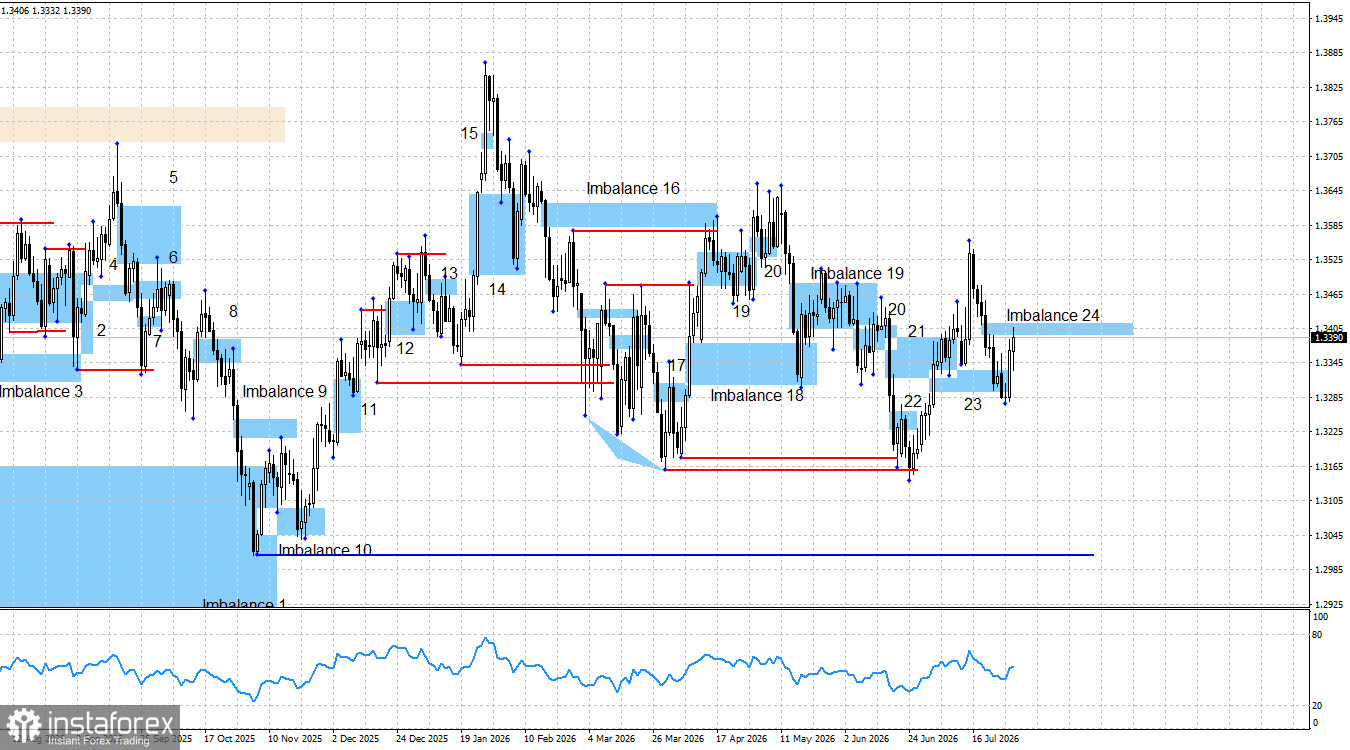
The GBP/USD pair has posted a fairly noticeable decline over the past two weeks, but it had previously experienced an even stronger rally. Therefore, I believe a new bullish trend may have begun about a month ago. The corrective pullback over the past few weeks has been stronger than I expected, but corrections can vary in magnitude. Recently, both the pound and the euro have been pressured by the market's unwavering belief that the FOMC would inevitably tighten monetary policy this year. Last evening, Kevin Warsh caused markets to question that assumption. Earlier today, the Bank of England adopted a more hawkish stance than expected. Three members of the Monetary Policy Committee (MPC) voted in favor of raising the interest rate despite UK inflation slowing to 2.6%. Most importantly, the prospect of a Federal Reserve rate hike had already been priced in about six weeks ago, whereas a Bank of England rate hike had not.
At the moment, the pound has reached Imbalance 24, from which a new bearish move could begin. As always, expectations alone are not enough—it is important to wait for a clear signal before opening positions. A bearish signal may emerge today or tomorrow. In addition, a new bullish imbalance may form later today. If that happens, traders will have two conflicting zones. In that case, attention should shift to the euro, which in most cases remains highly correlated with the pound. If the euro generates a buy signal within its own bullish imbalance, a rally in both currencies will become considerably more likely.
Last week, oil climbed to $100 per barrel, and the consequences of a renewed escalation in the Middle East and a blockade of the Strait of Hormuz could push prices as high as $120. Therefore, if events continue to develop according to the most pessimistic scenario—which currently appears increasingly likely—oil prices will continue rising and surpass the highs recorded between March and May. In that case, inflation in both the United States and the United Kingdom would begin accelerating again. If, however, the situation develops according to the optimistic scenario, oil prices could return to the $60–70 per barrel range. Under those circumstances, further Federal Reserve tightening might not be necessary, while the Bank of England is already no longer constrained by excessively high inflation. Consequently, the US dollar cannot currently rely on a hawkish central bank stance for sustained support, while the pound can count on support from the Bank of England only if inflation begins accelerating again.
The chart analysis indicates that the bulls launched an advance that was rather unexpectedly replaced by a bearish offensive. No bearish patterns or signals were formed before the decline began. Therefore, the bears have regained control, and Imbalance 24 remains available as a potential selling zone. However, an appropriate confirmation signal should form rather than relying solely on price reaching the imbalance. It is also worth noting that a bullish imbalance may form by today's close.
Thursday's economic backdrop was fairly eventful. US second-quarter GDP significantly underperformed expectations, the Bank of England adopted a more hawkish stance than traders had anticipated, and the US PCE Price Index came in below forecasts, pointing to easing inflation. As a result, nearly all of today's factors favored both the pound and the euro. Will the bulls seize this excellent opportunity?
The broader fundamental backdrop remains such that, in the long term, I continue to expect nothing other than a weaker US dollar. Neither the conflict between Iran and the United States nor the possibility of a Federal Reserve rate hike in 2026 has changed that view. Geopolitical tensions temporarily reminded the market of the dollar's safe-haven status, but the conflict has already passed its most active phase. The Federal Reserve intends to raise interest rates in 2026, which is supportive for the dollar. However, it should not be forgotten that tighter monetary policy would slow both economic growth and the labor market. Moreover, Kevin Warsh was appointed by Donald Trump to lead the FOMC in order to pursue a more accommodative monetary policy—a direction that Jerome Powell was unable to provide. Therefore, in my opinion, any appreciation of the US dollar is temporary and largely incidental.
July 31: The economic calendar contains no scheduled events. Therefore, macroeconomic news is unlikely to influence market sentiment on Friday.
The long-term outlook for the pound remains bullish, but the bulls have yet to launch a sustained advance. After liquidity was taken from the two most recent swing points, buyers mounted a respectable rally, but the bears soon regained control without any obvious catalyst. As a result, the pound may continue declining toward 1.3007, the level that would invalidate the bullish trend. Additional bearish signals will be required to confirm this move. A sell signal may emerge within the 1.3392–1.3415 level, where Bearish Imbalance 24 is located. At present, the bulls have no confirmed technical setup, although a new bullish imbalance may form later today.

