
यह भी देखें


 28.08.2026 11:23 AM
On Friday, the euro is once again under pressure ahead of Federal Reserve (Fed) Chair Kevin Warsh's speech at the Jackson Hole symposium, which will take place later today. At the beginning of the European session, EUR/USD is trading around 1.1640, down 0.3% for the week after gaining approximately 2.5% over the previous four weeks.
The main focus on Friday will be on the meeting of central bank heads in Jackson Hole, where Warsh is expected to provide further information on the Fed's plans to contain inflation, which remains above target levels.
Although Warsh is usually in no hurry to make specific statements, several central bank officials called for tighter monetary policy on Thursday amid persistently high price pressures. Federal Reserve Bank of Kansas City President Jeffrey Schmid noted in an interview with CNBC that inflation "remains elevated, and we need to continue looking for ways to control it," while Federal Reserve Bank of Cleveland President Beth Hammack added that "it is time to act," referring to the possibility of raising interest rates.
Inflation in the United States is indeed still significantly above the target, as confirmed by the Personal Consumption Expenditures (PCE) data released earlier this week. The data showed that consumer inflation increased by 0.2% in July, exceeding expectations of 0.1%. The annual growth rate remained steady at 3.7%, almost twice the Fed's 2% target. The core PCE index, which is more important for monetary policy, also showed a 3.3% increase over the 12 months through July, unchanged from the previous month.
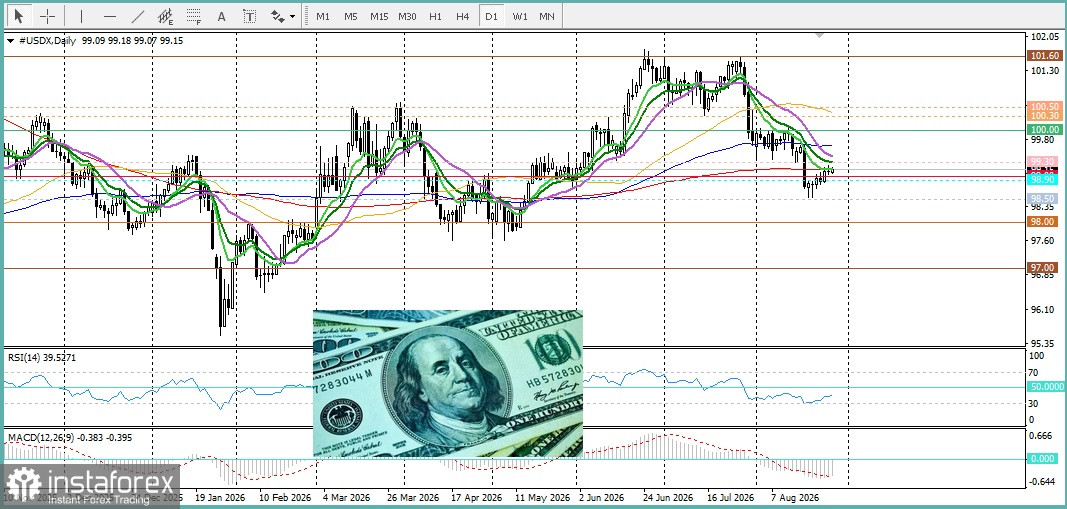
Scotiabank strategists view the current recovery of the U.S. dollar as a corrective process. "History shows that Jackson Hole can have a significant impact on market prices," Scotiabank experts note, adding that "one-week implied volatility is significantly below recent averages, suggesting that markets may be overly confident about Warsh's speech and its potential to influence markets." In this context, they "continue to view the rise in DXY as a correction against the backdrop of a still deeply entrenched downward trend on the charts."
As for the euro, ECB Executive Board member Isabel Schnabel recently noted the need for further interest-rate increases, citing the prolonged conflict in the Middle East and the surprising resilience of the eurozone economy as key factors contributing to inflationary pressures. These hawkish assessments have led to a shift in market expectations: according to the ECB Watch tool, the probability of the deposit rate being raised to 2.50% at the upcoming September meeting is estimated at almost 96%. This is helping to keep the euro above the important 200-day SMA.
From a technical perspective, the pair is showing resilience below the 200-day SMA, which favors the bulls. In addition, the oscillators are positive, confirming the bulls' advantage in the market. However, if prices fail to hold above the important 200-day SMA, the decline could accelerate toward the round 1.1600 level. The 20-day and 100-day SMAs are located near this level and could provide support during the decline. The resistance remains the zone ahead of the round 1.1700 level and the August high.

