
See also


 12.05.2026 08:38 PM
The GBP/USD pair made another reversal in favor of the pound and resumed its upward movement in full accordance with the current chart structure. Last week, the price reacted to bullish imbalance 20, thereby forming a new buy signal — already the fourth one in a row. Unfortunately, today the pound suddenly collapsed downward, despite there being no objective reasons or grounds for such a move.
However, I would like to point out that this is far from the first pullback in the pound recently. Over the past seven to eight days, Iran and the United States have violated the ceasefire at least three times, each occasion providing moderate support for the US dollar. Therefore, I cannot rule out that rockets were launched again today in the Middle East, or that new bombings took place that have simply not yet appeared in the news feeds. Alternatively, information may have emerged indicating that Iran and the US remain far from signing a comprehensive agreement and are still unable to break the diplomatic deadlock.
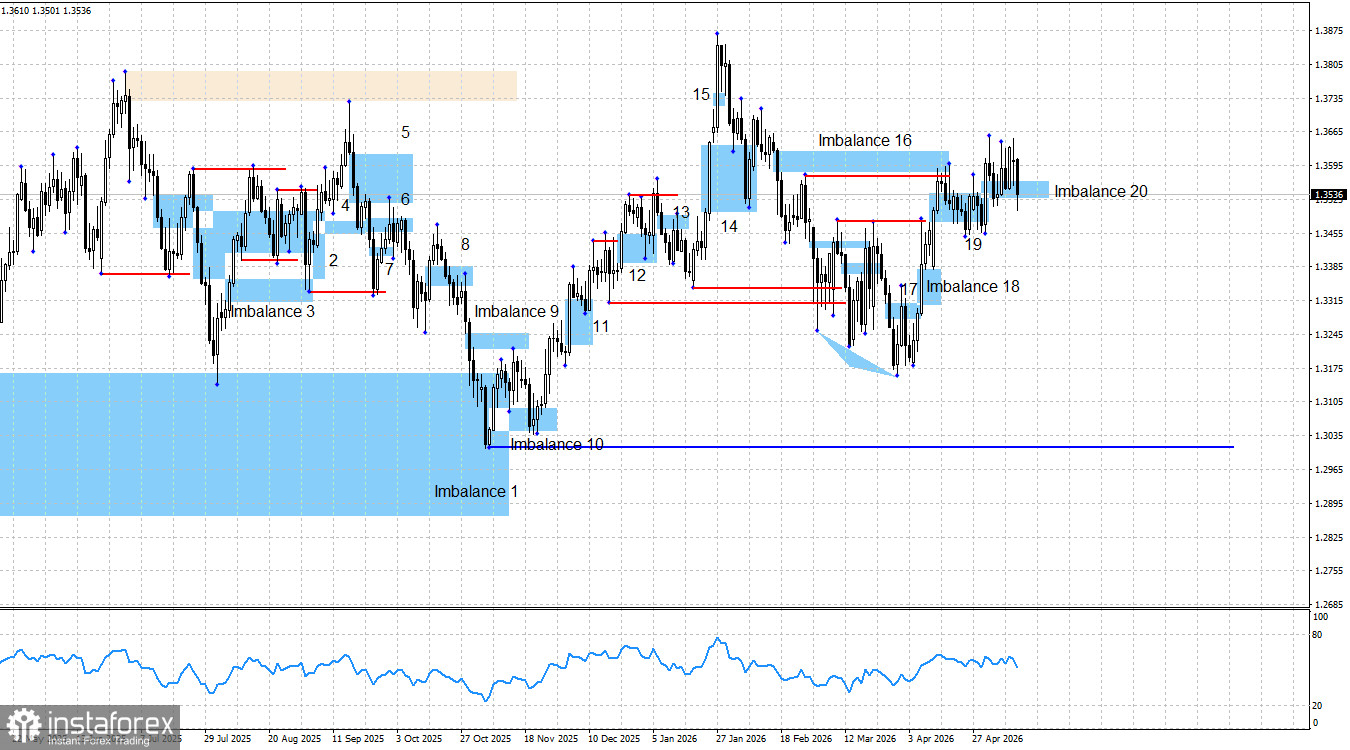
In any case, I do not believe the bullish trend is over. It will only be possible to speak about the cancellation of the bullish scenario after bearish patterns appear or bullish patterns become invalidated — neither of which is currently observed.
The situation surrounding the resolution of the Middle East conflict remains uncertain, while traders are still unclear about the next direction of the market. Today it may favor the bulls; tomorrow it may favor the bears. This is exactly the kind of picture we have been observing in recent weeks. At the moment, the bulls maintain the advantage, but if a new escalation occurs, the bears could launch a full-scale offensive.
The pound's rally began with a "Three Drives Pattern." Thus, traders received a bullish signal at the very beginning of the move, and the trend has remained bullish ever since. Currently, the ceasefire in the Middle East remains quite fragile, but the parties involved are still making attempts to reach an agreement, if media reports are to be believed.
At the same time, the market cannot rely indefinitely on news that is not confirmed by facts. Official negotiations may resume, but the conflict itself may also resume. The Strait of Hormuz remains under a dual blockade, while Tehran and Washington appear to have chosen a path toward lifting the blockade — though unsuccessfully so far. The situation is gradually improving, but far too slowly, and this can only be judged from unverified reports. Markets are overflowing with optimism, yet a harsh reality check could arrive at any moment.
The "Three Drives Pattern," marked on the chart with a triangle, allowed bulls to launch an offensive. Imbalance 18 allowed traders to open long positions, imbalance 19 provided another opportunity, and imbalance 20 did so once again. As a result, we have received four bullish signals within the current impulse wave. Geopolitics allowed the bulls to launch another attack, but it could just as easily turn in favor of the bears.
The economic news background on Tuesday was not the reason behind the pound's decline. The first significant US inflation report was released only several hours later, after GBP/USD had already fallen by 90 points. Therefore, geopolitics continues to be the sole factor influencing the market — even if this is not always obvious.
In the United States, the overall background remains such that, from a long-term perspective, little other than further dollar weakness should be expected. Even the conflict between Iran and the US changes little in this regard. Geopolitical tensions forced markets to remember the dollar's safe-haven status for two months, but overall, the long-term outlook for the US currency remains difficult.
The US labor market continues to weaken, the economy is approaching recession, the Federal Reserve — unlike the European Central Bank and the Bank of England — does not intend to tighten monetary policy in 2026, and four major protest movements against Donald Trump have already taken place across the country. In addition, the departure of Jerome Powell could worsen the situation for the dollar even further, especially if the FOMC under Kevin Warsh adopts a more dovish stance.
From an economic standpoint, I see no basis for sustained dollar growth.
The May 13 economic calendar contains only one secondary event. Therefore, the influence of the economic background on market sentiment on Wednesday may be extremely limited.
For the pound, the long-term outlook remains bullish. The "Three Drives Pattern" warned traders about the beginning of the rally, and since then, three additional bullish patterns and signals have formed. Therefore, despite geopolitical risks, I continue to expect further gains for the pound under current conditions.
At the same time, it must be acknowledged that geopolitics could still spoil the bulls' momentum. My target for the pound remains the 2026 high at 1.3867. The reaction to imbalance 20 allowed traders to open long positions for the third or fourth time already. At present, there are no bearish patterns or signals whatsoever.


