
See also


 28.05.2026 09:11 AM
Oil prices have sharply increased again — Brent has returned above $97 per barrel, and WTI is approaching $92. The catalyst for this rise was a new wave of strikes in the Persian Gulf: U.S. forces attacked a military facility near Hormuz, the IRGC retaliated against an American base, and Kuwaiti air defense systems reported intercepting missile and drone threats. The conflict has now lasted four months, and each time the market begins to believe an agreement is near, another escalation occurs.
At the same time, the U.S. Treasury imposed sanctions on the Maritime Administration of the Persian Gulf — a structure that, according to Washington, implements Iran's scheme to charge fees for passage through the strait. Trump was explicit in stating that the strait will be open to all, the U.S. will monitor it, and there will be no Iranian or Omani control over the waterway. This is a direct refutation of the version of the agreement previously announced by Iranian media.
The sticking points remain the same: Iran's nuclear program and control over the Strait of Hormuz. Trump openly stated that he would not accept an unfavorable deal or ease sanctions — directly contradicting a key demand from Tehran. It should be added that Trump is also feeling pressure domestically: Republican conservatives are demanding an extension of the war, which significantly narrows his negotiating space. Against this backdrop, the phone conversation between Iranian President Pezeshkian and Pakistani Prime Minister Sharif – the main mediator in the negotiations – seems more an attempt to keep the diplomatic channel open rather than a real breakthrough.
Meanwhile, the situation with fundamental supplies continues to worsen. The American Petroleum Institute reported a reduction in stocks of 2.8 million barrels last week, including a decrease at the key hub in Cushing. Official data will be released today. However, many experts believe that if China resumes imports by mid-July, the market risks a sharp spike in oil product prices. While this has not yet occurred, U.S. strategic reserves and reduced Chinese imports are partially mitigating the shortage — but this is a temporary buffer, not a solution.
For central banks, the situation remains extremely uncomfortable. Prolonged supply disruptions mean sustained inflationary pressure, which in turn puts pressure in favor of interest rate hikes. The Federal Reserve, European Central Bank, and other central banks have found themselves hostage to geopolitics: as long as the strait remains closed, they have virtually no room to ease policy, regardless of the state of the real economy.
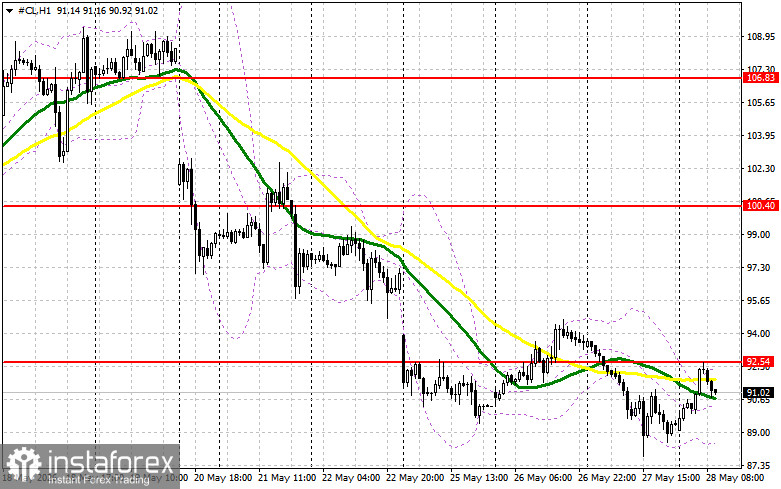
Regarding the current technical picture for oil, buyers need to reclaim the nearest resistance at $92.50. This will allow targeting $100.40, above which it will be quite challenging to break through. The farthest target will be around $106.80. If oil prices fall, bears will try to take control at $86.50. If they succeed, a breakout of the range will deal a significant blow to bulls' positions and push Oil down to a low of $81.40, with the prospect of reaching $74.85.


